01 · Project · Agriculture
Live lab · invite onlyA home farm
that looks after itself.
Seedlings start in a glass chamber. The plan: an arm hands them to Scout, a small robot, and Scout carries them to the rack where they grow. Cameras decide when, and check whether it worked.
Stream latency
~8 s → ~10 ms
Subsystems
5
Edge inference
NCNN FP16
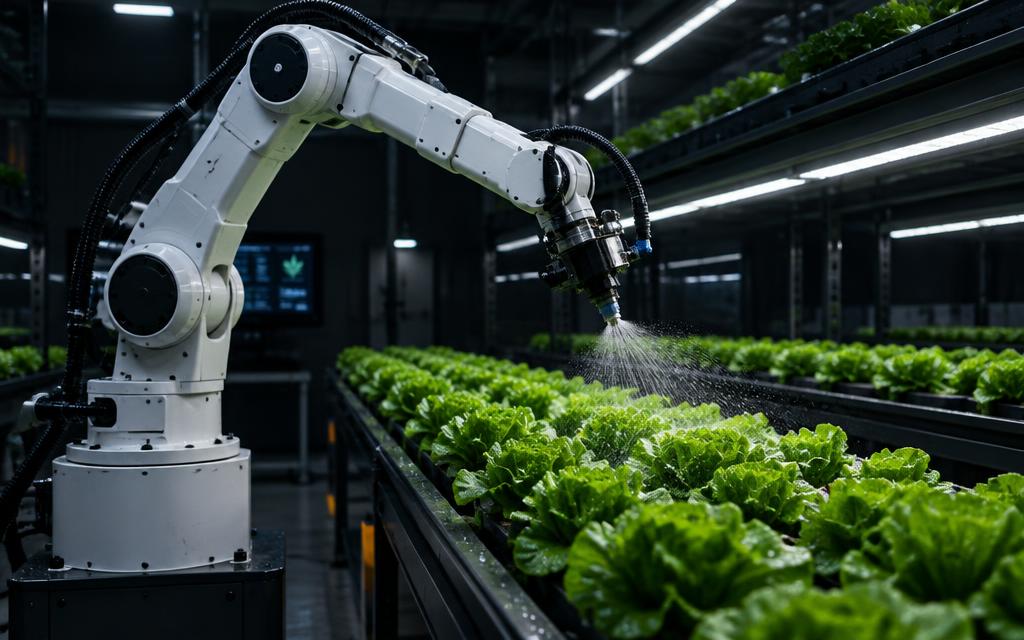
Robotic irrigation in an indoor farm — supplied Terra Hawk image
01 · The problem
Plants need care every day.
Could a few machines help?
Growing fresh food in a small apartment means watching plants every day: light, water, pH, temperature, and the moment a seedling is ready to move. Terra Hawk asks how much of that a small set of cameras, microcontrollers and robots can take over.
It is my personal R&D lab — every part is built, broken and rebuilt on a workbench. The goal is understanding what plants need, what machines can see, and how the two can work together.
Tools & methods
02 · Architecture
How it fits together.
Explore every link.
The ecosystem
Chamber, Scout, arms and rack, the Raspberry Pi 5 edge backend, MQTT telemetry and the web lab in one diagram.
ESP32 sensor nodes publish readings over MQTT; the Pi runs detection and tracking per camera and streams video over WebRTC. Scout runs ROS 2 on its own Pi 5, with an Arduino UNO R4 for the motors.
Open full screenThe data model
How units, sensors, readings and detections are stored.
Every reading lands in a database, so the dashboard shows both what is happening now and how the plants got here.
Open full screen03 · What I learned
Moving the public stream from RTSP to WebRTC showed me that latency is an architecture decision, not a tuning knob. Swapping models live, without a restart, made comparing YOLO and RF-DETR on the edge cheap enough to do every day.
04 · Live system
Request a guided demo.
Supervised, by invitation.
terra-hawk.com is the live system: real sensors and cameras in my apartment. Because it controls real hardware, access is by invitation, with short supervised sessions. Send me a note and I will walk you through it.
05 · Links
“That which is not good for the swarm, neither is it good for the bee.”