BSc Honours Thesis · University of Pretoria
Stellar Sight
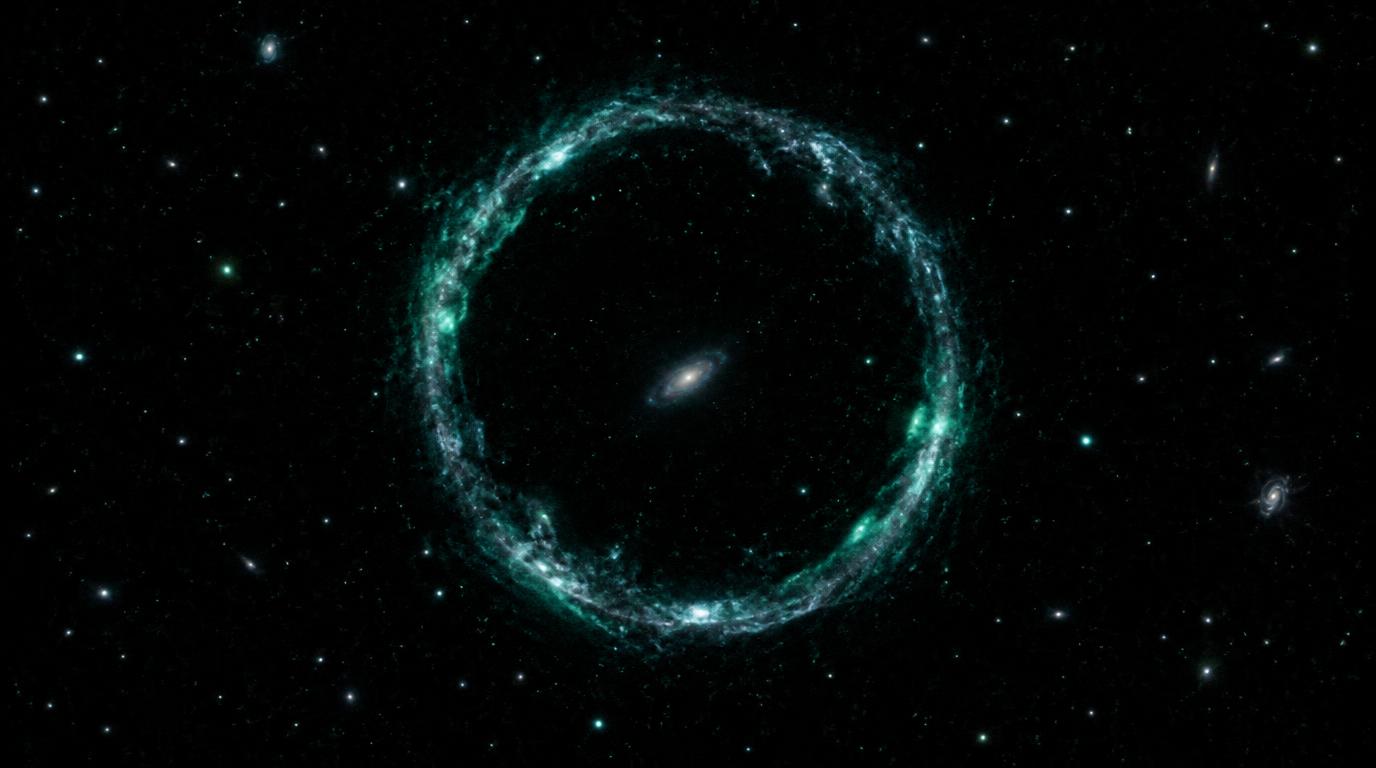
Illustrative Odd Radio Circle — generated image
Finding Odd Radio Circles with only a dozen examples.
The studyFew-shot learning with Siamese convolutional networks, compared across three CNN backbones and four augmented and non-augmented datasets of radio galaxies and ORCs.
Odd Radio Circles are faint rings of radio emission, first discovered in 2019, whose origin is still a mystery. With only a handful ever seen, standard deep learning has too little to learn from. This research asks whether a network can learn what “similar” looks like — and recognise an ORC from just a few examples.
Tools & methods
- Distinguishes ORCs from look-alike radio galaxies such as FRII and bent-tail sources.
- VGG-16 backbone consistently outperformed AlexNet and InceptionV3.
- Data augmentation proved decisive for generalising from scarce astronomical data.
Architecture at a glance
- 01
FITS radio images
Sigma-clipped to suppress noise
- 02
Augmentation
Flip · rotate · crop — 12 ORCs become 252
- 03
Twin VGG-16
Shared weights embed an image pair
- 04
L1 distance
Measures how alike the pair is
- 05
Similarity score
ORC, or another radio source?
91.6%
Accuracy · augmented ORCs
0.976
ROC-AUC
1.00
Recall
The full paper, notebooks and results live on GitHub.
Read the research“Everything harmonizes with me, which is harmonious to thee, O Universe.”